












1. Have a clear study plan
According to the two students, there are three main reasons to pursue the SAT. First, SAT preparation helps develop essential skills such as critical thinking, analysis, problem-solving, and English proficiency.
Second, many universities in Vietnam now use SAT scores for admissions and scholarships, especially institutions with international or English-taught programs. Finally, the SAT is a key requirement for overseas university applications, opening doors to global study opportunities.
With these goals in mind, they created clear SAT study plans, identifying strengths and weaknesses from the start. In addition to class time, they spent 3–4 hours of self-study daily, researching online resources and participating in learning forums.
2. Strengthen grammar and vocabulary
Hoàng Ngọc noted that many candidates lose points in SAT Verbal due to limited vocabulary and weak inference skills. He learned about 100 commonly tested words per day, using spaced repetition to retain them long-term.
For Writing and Language, he focused carefully on grammar, transitions, punctuation, and modifiers, aiming to avoid mistakes in what is considered the easiest yet most heavily penalized section.
Bích Ngọc found Reading particularly challenging due to long, academic passages and limited time. She emphasized building a strong vocabulary, especially for Words in Context questions.
She also pointed out that many Vietnamese students struggle with English math terminology, which affects SAT Math performance. To address this, she regularly used Quizlet to study vocabulary anytime, anywhere.
3. Master core knowledge and make use of Desmos
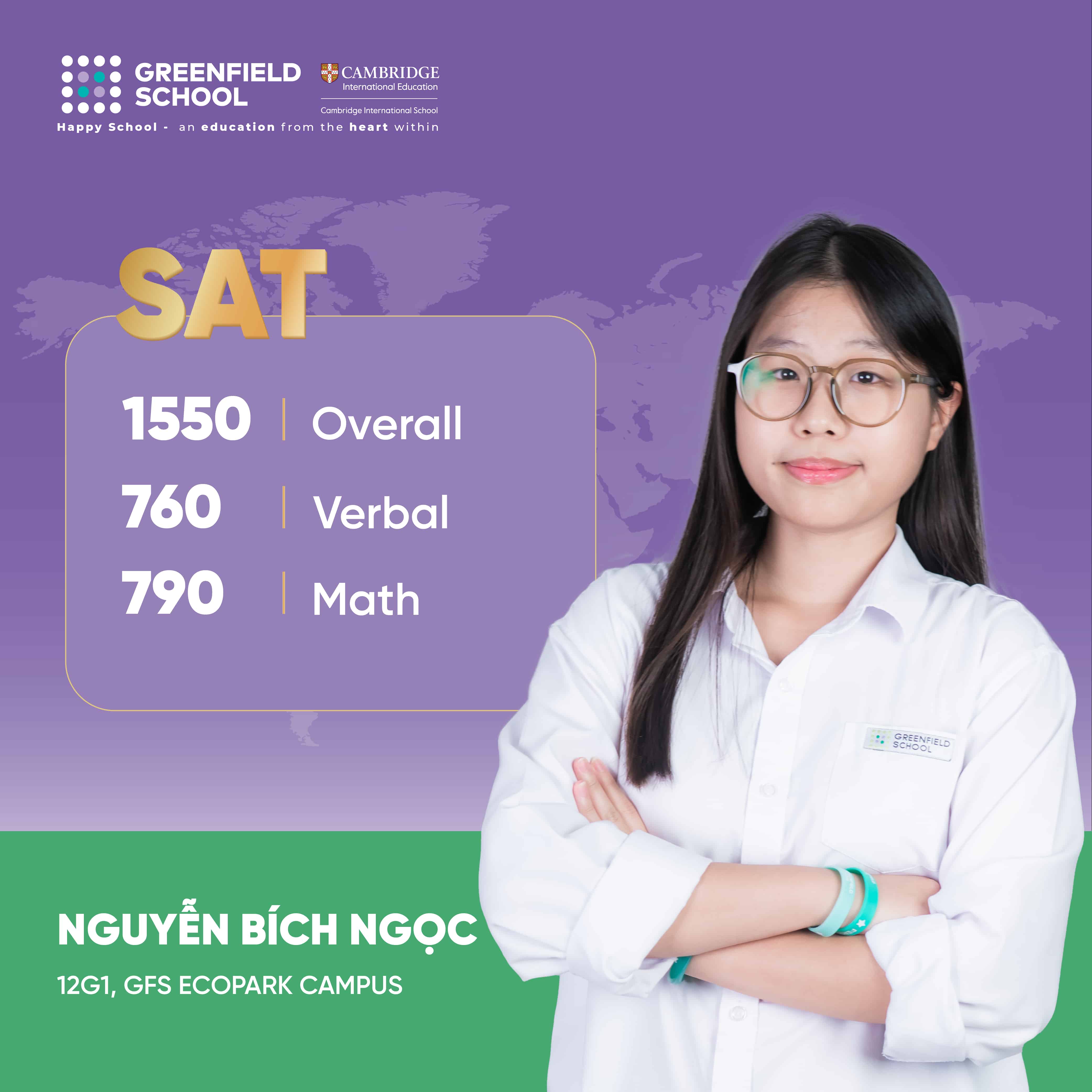
With near-perfect SAT Math scores (790/800), both students agreed that the Math section mainly tests foundational knowledge and application skills.
Bích Ngọc shared that mastering Vietnamese middle and high school math is usually sufficient, though SAT questions often include traps involving functions, graphs, and exponential equations. Careful reading and answer checking are essential.
Hoàng Ngọc added that students should learn to use Desmos, the built-in calculator for SAT Math, which allows graphing and equation solving without a handheld calculator.
4. Apply effective test-taking strategies
Beyond solid knowledge, both students emphasized the importance of time management—with roughly one minute per question, efficiency is key.
Hoàng Ngọc applied chunking and the process of elimination for inference and evidence-based questions. He typically tackled the last section first, then the beginning, saving the middle—often the longest and hardest—for last.
Bích Ngọc practiced with mock tests and used an error log to track recurring mistakes, helping her avoid common traps and make confident decisions during the real test.
5. Seek support
Both students highlighted the value of guidance from experienced mentors. Hoàng Ngọc learned from online resources, social media tips, and webinars with senior students. Bích Ngọc expressed gratitude to Ms. Nhi (IELTS teacher at Greenfield Ecopark Campus) for helping systematize common errors, answering questions in detail, and providing useful materials.
Notably, the integration of SAT preparation into the Global Citizen Bilingual Programme also helped both students become familiar with SAT question types and meet international academic standards.
With their SAT scores, Hoàng Ngọc plans to apply to universities in the United States and pursue scholarships in Europe, while Bích Ngọc is considering using her SAT score alongside an IELTS 7.5 to apply to top public and international universities in Vietnam.
Congratulations to these talented Greenfield School Ecopark Campus students. Wishing you continued confidence, success, and many achievements as you pursue your dream universities!







 APPLY
APPLY
 VISIT
VISIT
 INQUIRE